Foreign Ownership. On December 19, the USDA published an advanced notice in the Federal Register seeking public comment on proposed updates to the Agricultural Foreign Investment Disclosure Act (AFIDA). AFIDA requires certain foreign individuals or entities to report their interests in U.S. farmland. These reports are collected by the USDA and used to provide information to Congress on the effect of foreign ownership in rural communities. In the posting, the USDA cites flawed processes and “evolving national security concerns” as justification for the proposed updates. Comments are requested as to whether the reporting mechanism of AFIDA should differentiate between individuals or entities from nations that are non-adversarial or considered foreign adversaries, among other regulation revisions. Comments may be submitted here. The deadline to submit comments is January 28, 2026.
Revised FSA Programs. On January 12, the FSA and Commodity Credit Corporation (CCC) published a final rule to the Federal Register updating several FSA programs to comport with requirements introduced by the One Big Beautiful Bill Act (OBBBA). The affected programs include the Price Loss Coverage (PLC), Agricultural Risk Coverage (ARC), and Dairy Margin Coverage (DMC) programs. The final rule modifies provisions in the programs related to reference prices, effective reference prices, base acres, program elections, and payment provisions. Additionally, the FSA will be making “minor administrative changes and updates” to the programs mentioned above. Under this final rule, the enrollment process for the ARC and PLC programs has been delayed until FSA announces a deadline for enrollment later in 2026. The final rule took effect on January 12, 2026.
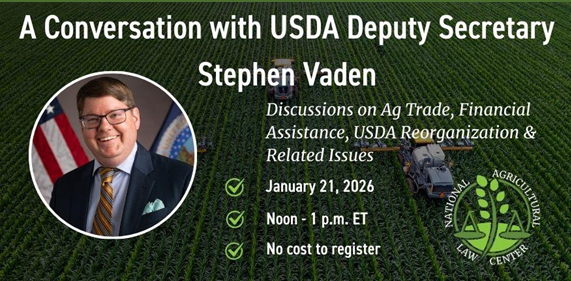
- Webinar Opportunity (January 21, 2026): Judge Stephen Vaden, USDA Deputy Secretary, will present an update on ag trade, financial assistance, USDA reorganization, and related issues. To register, click here.
Alternative Proteins: Ohio. On December 19, 2025, Ohio’s governor signed HB 10 into law. This legislation addressed “imitation meat and egg products” by creating labeling requirements for cultivated-protein food products, plant-protein food products, insect-protein food products, and fabricated-egg products. Specifically, this law requires that those products may not bear a term that “identifies” them as meat or eggs without also containing a disclaimer of their origins. Additionally, this law prohibits state education providers, such as state institutions of higher education or city boards of education, from purchasing cultivated-protein food products other than those for research. To learn more about other state alternative protein laws, click here to view NALC’s Alternative Protein Laws state compilation.
Oklahoma v. Tyson Foods. On December 19, a federal court in Oklahoma issued a judgment in the decades-old lawsuit Oklahoma v. Tyson Foods. The injunction, against Tyson Foods and other poultry companies, requires the defendants to fund a long-term cleanup and remediation plan for phosphorus pollution in the Illinois River watershed. It imposes a permanent injunction obligating the companies to establish and maintain a remediation fund (starting with an initial $10 million payment) covering at least 30 years of cleanup and monitoring, restricts poultry litter application to control runoff, and appoints a court-appointed special master to oversee implementation and compliance. The companies were also assessed $420,000 in civil penalties to be paid to the State of Oklahoma. Following the judgment, the poultry companies have filed notices of appeal and sought a stay of the court’s orders pending appeal.
NEPA. On December 18, the Center for Biological Diversity and the Sierra Club brought suit against the Department of the Interior. The groups claim that Interior is in violation of the National Environmental Policy Act (NEPA), which requires that federal agencies not only conduct environmental reviews of their proposed actions, but also requires public participation in those reviews. In late 2024, a federal court concluded that the federal regulations which had implemented NEPA for decades had been invalidly passed and ordered the Council on Environmental Quality (CEQ) to rescind them. CEQ did so, advising other federal agencies to adopt their own regulations for administering NEPA. Consequently, Interior did so, publishing its NEPA regulations in an Interim Final Rule on July 3 without a period of public comment. The new rules do not include any process for public input and focus largely on what types of projects are excluded from NEPA review. In the lawsuit, plaintiffs claim that this approach violates NEPA’s requirements of thorough environmental review and public participation. Recently, a federal court in Montana reaffirmed that NEPA requires agencies to take a “hard look” at the environmental impacts of their proposed actions, a ruling that could be relevant to the current lawsuit. With multiple agencies having yet to adopt their own NEPA regulations, this new challenge could serve as an indication of what courts will consider sufficient to comply with NEPA. To learn more about recent changes to NEPA, click here to view NALC article “CEQ Rescinds All NEPA Implementing Regulations.”
Delisting the Gray Wolf. The U.S. House of Representatives passed a bill that would remove gray wolves in the lower 48 states from the Endangered Species Act (ESA). The Pet and Livestock Protection Act, which passed in a 211-204 vote, now heads to the Senate which has traditionally been unwilling to intervene in Fish and Wildlife Service’s (FWS) ESA decisions. Notably, however, the bill is in line with a delisting rule for the gray wolf adopted by FWS in 2020 but struck down by a federal judge in 2022. It is possible that this previous attempt from FWS to delist the gray wolf could increase the likelihood that the Pet and Livestock Protection Act passes the Senate.
Pesticide Liability. The final version of the U.S. House Appropriations Committee’s Interior-Environment appropriations bill no longer contains language purportedly shielding pesticide manufacturers from liability in state courts based on claims that they failed to warn consumers about the health risks of using certain pesticides. This stems from an ongoing battle involving Bayer’s herbicide Roundup, which is currently on appeal to the United States Supreme Court. In the meantime, some states have passed bills limiting the liability of pesticide manufacturers in similar cases, and it is likely that more will consider the issue in 2026. To learn more about the question of preemption in pesticide injury cases, click here.
New Dietary Guidelines for Americans. On January 7, the USDA and U.S. Department of Health and Human Services (HHS) released the updated Dietary Guidelines for Americans, 2025-2030 (DGA). The new guidelines recommend people “eat real food.” Notably, the guidelines encourage higher consumption of protein, whole milk, whole grains, fruits, vegetables, while avoiding added sugar and refined carbohydrates. The guidelines suggest that Americans to consume full-fat dairy with no added sugars, eat whole vegetables and fruits in their original form, and incorporate protein into every meal. In response to the new DGAs, the Physicians Committee for Responsible Medicine (PCRM) filed a petition with the USDA and HHS Offices of Inspector General alleging the guidelines were influenced by industry priorities. The petition, submitted on January 8, alleges that the authors of the accompanying report had significant conflicts of interest that resulted in recommendations favoring certain economic interests. The PCRM requests that the guidelines be withdrawn and reissued using the Scientific Report of the 2025 Dietary Guidelines Advisory Committee.
- Upcoming article: On January 20, 2026, NALC Staff Attorney Emily Stone will publish an article on the updated Dietary Guidelines.
State Ban on Food Dyes: West Virginia. A federal judge in the Southern District of West Virginia has temporarily halted the enforcement of West Virginia’s ban on artificial dyes in food. Enacted in 2025, H.B. 2354 bans the sale of foods containing certain color additives, including FD&C Red No. 40, and prevents foods with those additives from being served in schools. The school food provision of this law went into effect in August 2025, while the statewide ban was set to go into effect in 2028. Last year, the International Association of Color Manufacturers challenged the law’s constitutionality and sought to prevent the enactment of the law while the lawsuit is ongoing. While the judge’s order temporarily halts enforcement of the state-wide ban on food dye additives, it does not prohibit enforcement of the school food provision. To learn more about the West Virginia law, click here to read NALC article “Food Law in the States – 2025 Update.”
Challenge to Cyclobutrifluram. On December 30, several environmental groups filed a lawsuit against EPA over its recent decision to approve the fungicide cyclobutrifluram for use in the United States, arguing that the agency ignored the risks of registering a pesticide which can allegedly break down into a per- and polyfluoroalkyl substance (PFAS) in the soil. Cyclobutrifluram was registered by EPA in early November for several uses, including on soybeans and cotton, after EPA concluded that the fungicide did not pose any human health risks of concern. However, the environmental groups argue that EPA’s approval of the fungicide violates the Federal Insecticide, Fungicide, and Rodenticide Act (FIFRA), claiming that EPA downplayed health risks of cyclobutrifluram such as an increased risk of cancer. The case has been filed in the Ninth Circuit Court of Appeals and could have the potential to address the definition of PFAS within the context of pesticides. The regulation of PFAS has been a growing environmental law issue for years and is one of the many topics that NALC will be watching in 2026. To learn more about top environmental law concerns going into the new year, click here to view NALC article “Top Environmental Law Topics to Watch in 2026.”
USDA FSIS: ‘Product of USA’ Guidance. In December of 2025, the USDA’s Food Safety and Inspection Service (FSIS) released an updated food labeling guidance for meat packing facilities. This guidance document does not carry the weight of law, but “help[s] establishments determine whether their labels must be submitted to FSIS . . . for approval.” Specifically, this document includes updated guidance for packing facilities that voluntarily include U.S.-Origin Claims such as “Product of USA” or “Made in USA.” This updated language reflects a 2024 FSIS final rule titled “Voluntary Labeling of FSIS-Regulated Products with U.S.-Origin Claims,” that strengthened the permitted uses of such labeling language. Additionally, the updated guidelines clarify rules on label claims like “Produce of USA and Canada,” and detail that the term “raised” is defined as “from birth to slaughter.” To learn more about the final rule, click here to read NALC article “USDA Finalizes Voluntary ‘Product of USA’ Rule.”
USDA SNAP Retailer Compliance. On December 30, the USDA’s Food and Nutrition Service released a policy memo clarifying food restriction waivers and retailer compliance in states implementing new SNAP food restrictions. The FNS states that the Office of Retailer Operations and Compliance (ROC) will be monitoring the SNAP retailers’ compliance with the requirements of the waivers. The memo notes that the ROC will go undercover to investigate a retailer and even attempt to purchase restricted items against the State’s food restriction policy. Following the implementation date of a state’s food restrictions, SNAP authorized retailers will have a 90-day grace period to comply. If a retailer is found to be non-compliant, after the 90-day grace period, the retailer will be served with a warning letter and given 30 days to comply. If the retailer is non-compliant after the 30 days, they will be subject to an involuntary withdrawal. Currently, 18 state waiver requests have been approved by USDA, and each of the approved states is set to go into effect in 2026. In response to this memo, industry representatives sent a letter to USDA requesting further information about the memo and expressing concerns with the involuntary withdrawal penalty. To learn more about the waiver request process, click here to read NALC article “Excluding ‘Junk’ Food from SNAP Benefits.”
Colorado River. In early January, the Bureau of Reclamation (Reclamation) released a highly anticipated environmental review document exploring and assessing various different approaches to managing the Colorado River after its current operating guidelines expire later this year. Reclamation, which manages several dams and reservoirs along the river, is responsible for adopting operational guidelines that address how and when water is delivered to water users throughout the region. Current operational guidelines expire in 2026, and it is currently unknown what future guidelines will be. Reclamation announced in 2023 that it had begun the process of developing a document analyzing five possible options for post-2026 operations. The recently released analysis explores those options and the impacts each would be expected to have on the Colorado River Basin. Atypically, Reclamation has not specifically identified one it prefers, even as the seven Colorado River states continue to negotiate over their preferences for future operations. The document will be published in the Federal Register on January 16 and will be open for a 45-day period of public comment. To learn more about some of the options Reclamation is considering, click here to view NALC article “Looking Ahead: As Guidelines on the Colorado River Set to Expire, Attention Turns to What Comes Next.”
State Food Dye Ban: New Jersey. New Jersey state senators have sponsored a bill that would ban food containing artificial dyes from being served in schools. S-3016 would prohibit schools in New Jersey from serving food containing specific artificial food dyes, food of minimal nutritional value, and food and beverages that list sugar as the first ingredient. Additionally, the bill states that food for human consumption shall be deemed adulterated if it contains brominated vegetable oil, potassium bromate, propylparaben, or Red Dye No.3. The bill is currently in committee and would have to be passed by both chambers of New Jersey’s Legislature and signed by the governor to become law.
Canada- CSA Incentive. In Canada, the province of Nova Scotia announced a new program that offers discounts to consumers who purchase food directly from local farmers. The Nova Scotia Loyal Community Supported Agriculture (CSA) Incentive Pilot will provide a 10 per cent discount to consumers, reimbursed to eligible participating farms and up to $2,000 of funding to aid farms in their CSA promotion. To learn more about the program, click here. To learn more about legal issues involved in United States CSAs, click here to read NALC article series “Community Supported Agriculture: A Field Guide for Producers and Consumers.”
- Upcoming webinar (February 18): Emily Stone, NALC Staff Attorney, will present “Community Supported Agriculture: A Field Guide for Producers and Consumers.” To register, click here.
Potential Ag Labor Reform. On January 11, 2026, House Ag Committee Chairman Glenn Thompson teased potential ag labor reforms in the first quarter of 2026. During a panel at the American Farm Bureau Federation’s annual convention, Thompson claimed that legislation related to ag labor had been drafted based on recommendations from a 16-person task force. Thompson cited farmer testimony as evidence of the program’s perceived issues. No official information or statements have been published at this time. Webinar Opportunity (February 4, 2026): Misty Wilson Borkowski, Partner, Hall Booth Smith, P.C., will present “Guarding the Gates: Ag Employer Readiness for ICE and DHS Actions.” To register, click here.