


Water has always been fundamental to agriculture. What is changing is the number of competing pressures surrounding it.
Farmers and ranchers are facing questions about water availability, pumping and treatment costs, water quality, regulations and competition from expanding communities and industries. That makes the economics of water increasingly important. Instead of simply asking where the next gallon will come from, producers may also need to ask how many times that gallon can economically be used.
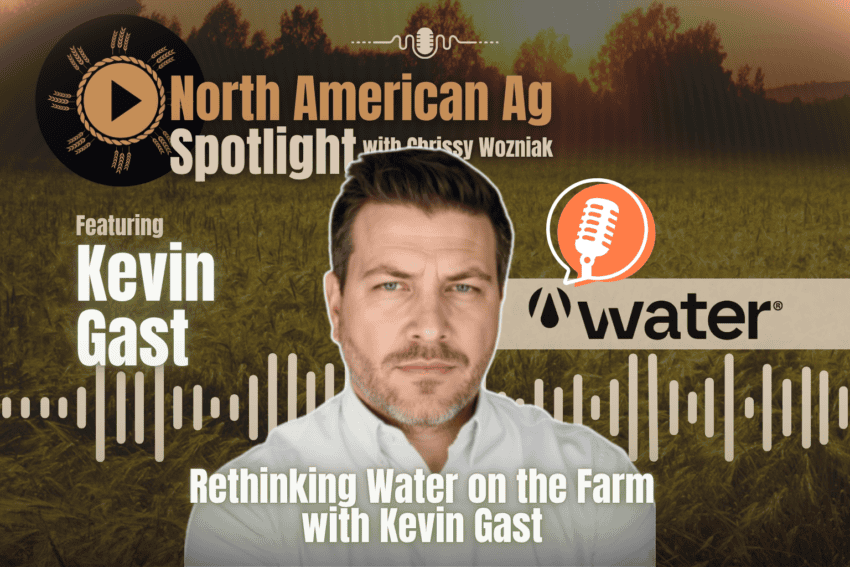
On North American Ag Spotlight, host Chrissy Wozniak spoke with Kevin Gast, Co-Founder, CEO and Chairman of VVater, about a different approach to water treatment that uses electricity as a central part of the treatment process.
Moving Beyond Traditional Water Treatment
Gast’s background includes construction, civil engineering, pipelines and water treatment. Through that experience, he said he encountered many of the conventional technologies used to treat water, including filtration, membranes, chemicals and biological systems.
Those systems have important applications, but Gast argues they can also bring operating costs associated with filter replacement, membrane maintenance, chemicals, energy and waste streams.
VVater is developing an alternative based around electrically driven treatment.
At the center of its technology is the Farady Reactor, which uses the company’s Advanced Low Tension Electroporation Process. VVater says the technology uses low-energy electric fields and can operate without the filters, membranes and chemical consumables associated with many conventional treatment approaches.
For agriculture, the company says its systems can be configured for irrigation and water reuse applications and incorporated into existing operations.
What Could This Mean for a Farm?
One of the most important points Gast makes is that there is no single treatment configuration for every agricultural operation.
Water varies dramatically from one location to another. Before recommending a system, Gast said VVater looks at three basic questions: What is in the incoming water? How much water needs to be treated? And what quality of water is required after treatment?
A livestock operation needing water for animals may have different requirements than a greenhouse, irrigation system or food-processing facility.
That ability to tailor treatment to the required output could also allow farms to consider water sources that might otherwise be unusable.
Gast discussed the possibility of treating contaminated or wastewater sources for agricultural reuse, depending on the water chemistry and intended application. For farms in areas where freshwater supplies are constrained, creating usable water from an alternative source could become increasingly valuable.
Recovering More of the Water Already Available
Water recovery was another major part of the conversation.
Gast compared VVater’s approach with reverse osmosis systems, which can generate a concentrated waste stream during treatment. He said VVater systems can achieve recovery rates of approximately 95% or higher in some applications, with the exact performance depending on the treatment configuration and incoming water.
Those figures are company claims and will vary by application, but the underlying concept is significant for agriculture: the value of treatment is not only what contaminants can be removed, but how much usable water remains after treatment.
When water can be captured, treated and returned to an operation, the same resource can potentially serve the farm repeatedly rather than being discharged after a single use.
Making the Economics Work
New technology means little to producers if it cannot generate an economic return.
Gast said removing or reducing consumables such as chemicals, membranes and replacement filters can lower ongoing treatment expenses. VVater currently says its agricultural treatment systems can reduce operating expenses compared with traditional systems, although actual savings depend on the application and existing treatment infrastructure.
The company is also offering what it calls VVater-as-a-Service. Under that model, qualifying customers can avoid purchasing and managing the entire system themselves. VVater can provide financing, maintain the equipment and manage the treatment system under a longer-term agreement.
For a farmer, that changes the conversation from purchasing another piece of complicated infrastructure to potentially buying water-treatment capacity as an operating service.
Technology Farmers Don’t Have to Babysit
Labor is another consideration.
Gast said VVater’s systems are designed to be highly automated and remotely monitored. With relatively few moving parts and without routine chemical dosing or filter replacement in its core treatment technology, the goal is to minimize the amount of attention required from the producer.
The systems are also modular and can be retrofitted into existing water infrastructure. That matters because farmers already have enough technology demanding their attention. A water treatment system becomes far more practical if it can operate in the background rather than creating another daily management responsibility.
Agriculture and Data Centers Competing for Water
The conversation also turned to one of the fastest-growing water debates in the country: data centers.
Gast said older data-center designs can consume substantial amounts of water, while newer closed-loop cooling designs can significantly change that equation. Regardless, he believes water availability is becoming a central question when new facilities are planned.
That matters to agriculture when data centers, municipalities, residents and farms depend on the same aquifers or other freshwater resources.
Gast sees water reuse as one potential way to reduce that competition. Instead of drawing exclusively from an aquifer, an industrial facility could potentially treat municipal wastewater or another discharge stream and turn it into a usable resource. The same principle applies to agriculture.
The long-term opportunity may not simply be finding more freshwater. It may be expanding the amount of water considered usable.
Treating Water as a Resource
Gast believes access to clean water will become increasingly valuable over the coming decades. His own interest in the issue is partly personal. Growing up in South Africa, he saw firsthand what serious water shortages could mean for communities.
For agriculture, the implications are immediate. Farmers cannot grow crops or raise livestock without dependable water. But as competition increases, the industry may need to look beyond the traditional model of withdrawing freshwater, using it once and allowing it to leave the operation.
Technology capable of treating and repeatedly reusing water could change that equation. The ultimate question for farmers will be the same one that accompanies almost every new agricultural technology: Does it work on my operation, and do the economics make sense?
For water treatment and reuse, that calculation may become increasingly important.
Learn more about VVater and its agricultural water treatment technology at VVater.com.
TRANSCRIPT
00;00;17;21 – 00;00;39;27
Chrissy Wozniak
Hi, and welcome to North American Ag Spotlight. I’m Chrissy Wozniak. As we all know, water is one of the most important inputs on any farm. But the conversation around agriculture water is becoming much bigger than simply having enough of it. Growers are dealing with rising pumping and treatment costs, changing water quality tighter regulations and increasing competition for water from growing communities and industries.
00;00;39;29 – 00;01;03;26
Chrissy Wozniak
For a grower, the question is ultimately economic can we get more value from the water that we already have? Can water be treated and reused at a lower operating cost? And can newer technology help growers protect yields and maintain access to reliable irrigation water without adding another expensive, complicated system to farming, which is increasingly more complicated these days with technology.
00;01;03;28 – 00;01;27;01
Chrissy Wozniak
One company is emerging that challenge differently by using electricity, rather than relying on traditional chemicals, membranes or filters to treat water. Today, we’re going to take a look at what that technology actually does, where it fits in in agriculture, and most importantly, whether the economics make sense for farmers. Joining me today joining me today is Kevin Gast, co-founder, CEO and Chairman of water spelled VV a t e r, a next generation water technology company developing advanced water treatment and reuse systems for agriculture and other industries. Kevin, welcome to North American Ag Spotlight.
00;01;31;03 – 00;01;41;02
Kevin Gast
Chrissy, thanks very much for having me. And with my best text and accent, I’ll say it as water with the two V’s. But if you’re probably just out of the US would be water.
00;02;00;21 – 00;02;07;18
Chrissy Wozniak
So before we get into the technology, tell us a little bit about your background and what led you to start water.
00;02;07;20 – 00;02;31;09
Kevin Gast
So very simply, as you can hear from my accent, it’s not very tech, sunny. But I am based out of Austin, Texas, but originally born and raised in Pretoria, South Africa. And I ran a much larger conglomerate entity, and that conglomerate entity was, dealing with a variety of different, applications from construction, civil engineering, pipelines, water treatment, and you name it.
00;02;31;09 – 00;02;53;26
Kevin Gast
And we’ve probably kissed every frog underneath the sun when it comes to water treatment tech, be it membranes like our road systems or filters or chemicals or biologicals. And we realized a few years ago that, you know, all of these technologies have great attributes and great applications, but they also have side effects, byproducts that are costly, heavy to maintain, and we have to come up with a better way.
00;02;53;28 – 00;03;04;13
Kevin Gast
And we’re one of the very few companies in the world that ended up pioneering, what is now referred to as sort of an electrical based water treatment system. And we’re at the cutting edge of what is doable.
00;03;04;15 – 00;03;15;04
Chrissy Wozniak
Yeah. That’s amazing. So let’s start with the grower. What are the biggest water related costs or problems that you’re seeing on agriculture operations today?
00;03;15;06 – 00;03;33;12
Kevin Gast
I think everybody’s struggling for the same resource. And that resource is not infinite. I think what a lot of people don’t realize is planet Earth is a big reuse recycling machine of water. You know, the irony of it is, is that if you wash your clothes every day, you reuse it. You don’t just buy one set of clothes, you wear it once and then throw it away.
00;03;33;14 – 00;03;51;23
Kevin Gast
You keep on washing us. And the water molecule that we find today is probably the same water molecule that we could have found in a dinosaur’s stomach, you know, millions of years ago. So the thing keeps on cycling over and over, and there’s not new water being produced. You can cloud seed, you can pull moisture from the air, you can do all sorts of interesting things.
00;03;51;23 – 00;04;13;24
Kevin Gast
But it boils down to the same thing, which is there’s not new water coming from somewhere. So we don’t have like an asteroid full of water hitting Earth every day. So the idea of having to reuse the water is the most sane and logical way of doing this. The question is, how do we do that? And I think for a lot of ranchers, farmers, we’re all fighting for the same resource.
00;04;13;24 – 00;04;38;13
Kevin Gast
And with the with the birth of AI data centers, massive infrastructure rollout, that, pie is just getting smaller and smaller, and that’s it’s becoming a lot more valuable. And I think, if I recall correctly, Deloitte put out a piece a few years ago that said that within the next 10 to 15 years, water or clean water in particular is going to be a bigger resource or a bigger commodity value than gold.
00;04;38;16 – 00;05;00;02
Chrissy Wozniak
Wow. That that is very interesting. And, and a great illustration too. I like that, your, a lot of your material online says that that, you can reduce operating expenses by 15 to 30% compared with traditional treatment systems. So what costs are actually being eliminated or reduced to create those savings?
00;05;00;04 – 00;05;16;16
Kevin Gast
Yeah. I think if you look at what’s traditionally being used, water treatment is done in four ways. It’s either a filtration system, those filters get clogged and you don’t remove them and replace them, which comes at a cost. You either have a membrane system, which is like a filter, but much smaller aperture sizes, little baby gaps.
00;05;16;19 – 00;05;37;19
Kevin Gast
And you’ve got to use high pressure, gases and compressed air to push things through that, which is a membrane like reverse osmosis. And those things get clogged as well, or they get a biofilm or sediment formation. So they need to be cleaned up, regularly replaced, etc.. And then chemicals. So chlorine, a lot of disinfection methodologies and obviously chemicals is very, very expensive.
00;05;37;19 – 00;05;54;18
Kevin Gast
I think chlorine went up with three x just in the last few years. Not to mention the also requirements, health and safety, all those other elements to it. And last but not least, you have good bacteria that the you know, that eats the bad bacteria side of things. So if you look at those opex elements it is very intensive.
00;05;54;18 – 00;06;15;15
Kevin Gast
They also have a bunch of side products. So if you use a reverse osmosis system you generate a highly contaminated brine. Then you need a another system to be able to handle the waste or the system. And then this cycle just keeps on going. So depending on what that looks like, we say we can save up to about 80% on the operational expenditure because we don’t have any filters to replace.
00;06;15;15 – 00;06;32;29
Kevin Gast
We don’t have any chemicals to add into it. And what you do is, you have what we call a Faraday reactor, our award winning Faraday reactor. We use very, very little energy. And the energy I’m talking about is below 12 volt. And that’s what makes it so fat. Fascinating. So the energy that you use is very, very little.
00;06;32;29 – 00;06;54;07
Kevin Gast
And those electrodes inside those reactors, that material doesn’t deteriorate as quickly because you don’t have that high amount of energy. So their life cycle is a lot longer, like ten plus years before you start getting, dilapidation and degrading of those electrodes. And they need to be replaced. Hence, from an operational expenditure, it is significantly more efficient.
00;06;54;09 – 00;07;06;15
Chrissy Wozniak
Wow. Yeah. And so for growers, when they hear water treatment, I’m sure they immediately think of another major capital expense. So where’s financial opportunity and where where does this fit on the farm.
00;07;06;17 – 00;07;24;20
Kevin Gast
Yeah. So the way we’re approaching it, again, depending on what those applications are, we look at three different things. One is what is the water analysis or chemical analysis look like of the water that comes to us. You know, what is container that because every water makeup looks different. The water on my ranch on my farm is different to yours.
00;07;24;23 – 00;07;42;01
Kevin Gast
And they differ. So we need to understand what does that look like? Secondly is how much water needs to be treated as a one gallon a day. Well, 50 million gallons a day, because obviously that changes quite a bit. And then lastly, what’s the desired output on the back end? Do we need, portable drinking water? Maybe we just need irrigation water.
00;07;42;01 – 00;08;03;07
Kevin Gast
Maybe we need ultra pure medical grade water for semiconductor manufacturing. So those three elements really change and dictate what is your price? What is the scale? What is the application to it. Now on a typical ranch or an agricultural setting, we see that, tying in with a multitude of different solutions, already in place. And we can retrofit very easily.
00;08;03;09 – 00;08;25;06
Kevin Gast
We also offer something which we call, water as a service vvas. In other words, we can provide the capital to finance the entire thing. And then our customer then signs a ten year contract with us, and they pay it monthly, like a lease on a car, except that capital expenditures for over a long period of time, especially our more larger commercial agricultural, partners, I see.
00;08;25;06 – 00;08;34;20
Chrissy Wozniak
And can you explain, the Faraday reactor, and what is actually happening to the water as it moves through the system.
00;08;34;22 – 00;08;52;15
Kevin Gast
You know, so the Faraday reactor is one piece of the puzzle. We have a multitude of other different technologies, because, again, that water make up on how it looks like it can be vastly different. And we have different solutions for those things. So you don’t have this, magic black box that just fixes everything, right? We all wish that would exist, but that’s not the case.
00;08;52;17 – 00;09;24;23
Kevin Gast
So the Faraday reactor, its primary purpose is destruction. It destroys. It kills. So if you are looking specifically at microorganisms, bugs, bacteria, viruses, protozoa versus those type of things, it is exceptionally good at doing that. And that is to disinfect your water. And it does it very, very efficiently. The second part that it does is and the way I always explain it is you have a butcher’s cleavers knife and this is a special knife because this knife can cut through anything and anything in the chemical chain format of how things are put together.
00;09;24;23 – 00;09;43;12
Kevin Gast
That knife can break those chains. So that helps you, able to move things around or separate things within the sort of larger chemical makeup of what water is. And that’s a great thing to do because a lot of technologies, you need multiple different steps just to do those two things. So the Faraday reactor does that exceptionally well.
00;09;43;14 – 00;10;01;27
Kevin Gast
Now a lot of the times everything’s been killed, everything’s destroyed. You could probably drink that water. It might be a little bit chewy at the end of the day. Because you might be left with, you know, carcasses, debris, skeletal mats or whatever that might be. We then run it through a separate machine, which we call an advanced dissolved, er, flotation device.
00;10;01;27 – 00;10;21;00
Kevin Gast
And then the most simplest way of explaining it, we have little micro bubbles and nano bubbles inside this thing that help float. And for flocculant as the official name, float those things to the top, all of those particulate and all that heavier stuff, the precipitation pushing that down to the bottom. And then we skim that off. And that piece in the middle is relatively good clean water.
00;10;21;00 – 00;10;41;04
Kevin Gast
So for us, we have all of these solutions depending on what’s coming into us and what’s going out. Now, maybe just to wrap up on on the question, we are looking at developing a sort of an all in use, solution. We call it shield, which is also marked for the residential market. You put it in your garage or attic, your basement, and it also does water softening.
00;10;41;04 – 00;11;04;23
Kevin Gast
So one flick of a switch uses less amount of energy than a typical tumble dryer. And you have actually clean water at the end of the day. And from an agricultural perspective, I think the biggest risk we find is what is inside that water from nitrates, phosphates, microorganism contaminants. And these solutions provide direct, head on solutions for those problems.
00;11;04;25 – 00;11;11;06
Chrissy Wozniak
Right. Yeah. We hear a lot about fast and microplastics. Can you also deal with that.
00;11;11;09 – 00;11;27;05
Kevin Gast
Yeah. So endocrine disruptors. So hormone disruptors trace pharmaceuticals microplastics and nano plastics are something that we do very easily. We’re in advanced stages with our fast destruction technology, and we hope to have a dedicated product out next year for that as well.
00;11;27;07 – 00;11;46;06
Chrissy Wozniak
Yeah. Very cool. So I can immediately see so many uses like especially greenhouse, you know, greenhouse landscaping. Even golf and turf as well. So, you know what, what kind of crops or what kind of animal is it also for, for you said ranching and livestock too, right?
00;11;46;09 – 00;12;01;25
Kevin Gast
100% correct. Yeah. So, I mean, we can take the water all the way to a portable drinking water standard at the end of the day. So, you know, it’s great for human and animal use. But I think we a lot of the use cases are is the ability to find alternative water sources. So you need to irrigate your crops.
00;12;02;01 – 00;12;20;01
Kevin Gast
You need to feed, and provide, water for your livestock. You don’t have you’ve got a maybe a well, or something else. And how do you get that water to a certain quality? And this gives them, a higher opportunity to take a wider variety of contaminated water, be it wastewater, sewage, water. We can treat that like that.
00;12;20;01 – 00;12;36;06
Kevin Gast
Potable drinking water or indirect potable drinking water where it could be utilized for irrigation spraying. And you have high nitrates and high phosphates with which helps greatly for the fertilization. Again, so we can play around with a lot of those elements to help the agricultural sector.
00;12;36;09 – 00;12;51;14
Chrissy Wozniak
Interesting. And I read too, that, in agriculture operations, you might be able to reduce the water use even, significantly through that, through that reuse. Can you explain, you know, how how would a grower calculate that value of the recovered water?
00;12;51;16 – 00;13;13;15
Kevin Gast
Yeah, I think the key is if you have to take it in comparison to something like reverse osmosis is a great example in our road system with a lot of those systems, you know, their recovery rate is very low, so they generate a large waste factor. So if you get 100% water coming out, coming in, you probably will only be able to recover 70, 80% of that water at the high peak, and you lose 20% to waste.
00;13;13;15 – 00;13;33;03
Kevin Gast
And that waste is really contaminated. And you need to do something with it. Where our system is different, we recover up to about 95% plus of that. So what what comes in versus what goes back out again is very usable. And you’ve got a very small amount of waste that is generated in certain settings as low as 0.2%.
00;13;33;05 – 00;13;54;02
Chrissy Wozniak
Oh, that’s that’s incredible. So does the cleaner irrigation water translate into measurable, measurable agronomic benefits like fewer clogged irrigation systems? I can see that, better crop performance. Can you add back in, fertilizers? Do you have any use cases like that?
00;13;54;04 – 00;14;09;01
Kevin Gast
Yeah, I think the key lies is, you know, you can keep on reusing that same water source. Not sure you’re going to lose some to evaporation and various other different things, but it’s still the same source you can just keep on using over and over again. And depends on what your design looks like and how you can crop it.
00;14;09;01 – 00;14;16;12
Kevin Gast
So yes, you can add in chemicals at a later stage. I mean, there’s many ways we can we can skin that cat at the end of the day.
00;14;16;15 – 00;14;20;24
Chrissy Wozniak
Cool. So outside of agriculture, where is this technology being used?
00;14;20;26 – 00;14;45;11
Kevin Gast
I think primarily it’s for industrial applications. So a lot of the, the larger industries, industries, food and beverage manufacturers, they fly three things normally. One is they don’t have, water sources or high quality water sources. So for them to manufacture something, they need to go and find a feed stock water to feed that manufacturing facility so we can provide them a wider variety of options instead of just miscible potable drinking water.
00;14;45;13 – 00;15;02;16
Kevin Gast
The second part is, once they’ve manufactured something, they have a contaminated liquid coming out of the back end and they need to meet some or other regulatory requirements. And we help manage that as well. And control that in a much more cost efficient way. And then lastly, they say, well, you know, we are discharging all of this water.
00;15;02;16 – 00;15;25;06
Kevin Gast
Why don’t we just reuse it again and feed it back into the front of the manufacturing facility and create a closed loop system? So that’s a big benefit. At the end of the day, I think secondary is what we call DPR, direct potable reuse and a lot of them into polities and the cities. And I think what people don’t realize when you flush the toilet, you know, those condoms, tampons, pads, everything goes down the toilet.
00;15;25;06 – 00;15;35;02
Kevin Gast
It ends up at a wastewater treatment facility, including the medication. All the hormones, everything goes down there. The pharmaceuticals, they handle the big organics.
00;15;35;04 – 00;15;36;02
Chrissy Wozniak
Think about.
00;15;36;04 – 00;16;01;14
Kevin Gast
It. So they remove all of those things, which is great. But what they don’t remove is the trace pharmaceuticals, the endocrine disruptors, all of those facets. There’s no way to treat that. Sure, they kill the microorganisms. They then take that and it gets discharged into a river, a creek or a well. It runs its natural course. Mother nature tries to do its best to treat those things, but it can’t handle trace pharmaceuticals and endocrine disruptors because that’s not natural.
00;16;01;17 – 00;16;32;19
Kevin Gast
It eventually ends up in a lake or a dam, and then from there it goes to another treating, drinking treatable, treating a water facility that has chlorine or some other form of disinfection. And it goes back in your tap and that’s the cycle. So what we do is we go, right behind the wastewater treatment facility, and we pick up that water and we skip the whole Mother Nature part as well as the drinking water treatment facility, and then get you straight drinking potable water from there, or indirect potable reuse, meaning from a wastewater as waste coming off of it.
00;16;32;25 – 00;16;51;11
Kevin Gast
We actually have a resource now which is seriously, seriously valuable. So that’s our second use case. And then third and last, but is on site reuse. So data centers, golf courses, corporate buildings, a lot of things where it’s a decentralized model because the biggest cost of water at the end of the day is the cost of transport.
00;16;51;11 – 00;17;04;19
Kevin Gast
Moving it from one place to another. And if you can put your treatment facility right there where you need it, it’s a lot more efficient to do it that way. And spending all of that money for piping and civil works and earthworks and so on.
00;17;04;21 – 00;17;33;00
Chrissy Wozniak
All that is remarkable. Amazing. Especially, in the wastewater treatment. That sounds so much more efficient than allowing time and nature to, to take the hit. So one of the biggest barriers to adopting farm technology is, is really the upfront investment. Are there any models that allow growers to adopt technology without owning and maintaining the entire entire treatment system themselves?
00;17;33;03 – 00;17;51;00
Kevin Gast
Yeah. As I mentioned earlier, that’s what we do is that water is a service vvas. And it’s sort of just a play on software as a service. Same concept. Where our growers come in, like, and sign an agreement with us. If they meet that credit profile, we provide that capital financing on our end through our own balance sheet.
00;17;51;02 – 00;18;07;21
Kevin Gast
We maintain it, we manage it, we make sure it’s everything’s taken care of. And the whole point is, I come from South Africa. I have a game farm out there. You know, I understand Lyons, I understand, viola BS had a son, all of those things. But I’m not necessarily a farmer. That’s not what I do every day.
00;18;07;21 – 00;18;24;00
Kevin Gast
I don’t grow agricultural crops. Somebody else does that. That’s what they’re really good. And we want to make sure that I can focus on that. We’ll handle the water part for them because they’re not water experts all the time. And that’s where we can come in. And to handle some of that responsibility. And we can provide that funding for them as well.
00;18;24;02 – 00;18;36;21
Chrissy Wozniak
Oh, that’s that’s very cool. So if somebody is would be interested, what is that process. Would they come to you and you know, what information do they need to have? And, and how does that process go?
00;18;36;23 – 00;18;59;13
Kevin Gast
Easiest is just to approach us on our website which is vtr.com. So two BS to make a w basically. And that’s the easiest way to reach out to us. Normally the three things that we need, as I mentioned earlier, is one is what does that water look like that we need to treat? If there’s a water analysis, chemical analysis, how much water needs to be treated as of one gallon a day or 50 million gallons a day?
00;18;59;15 – 00;19;13;02
Kevin Gast
And what’s the desired quality of the water that needs to come out on the back end? Do we need recreational water, irrigation water, potable drinking water? And just those three elements helps us dictate very quickly what that system looks like and what the cost could be.
00;19;13;04 – 00;19;20;20
Chrissy Wozniak
Yeah. Cool. And and what kind of what does maintenance look like and training labor once it’s operational on the farm.
00;19;20;23 – 00;19;43;19
Kevin Gast
Yeah. So technically it is maintenance free. But even you know the best Rolls Royce needs a bit of a tweak from time to time. So because you have very little moving parts, there’s no filters to swap out. No chemicals to dose. The maintenance is a lot less, we try and provide semi-autonomous and autonomous solution. So everything is fully centralized, packaged, opening and closing valves of feed to our command centers.
00;19;43;19 – 00;20;04;03
Kevin Gast
We can monitor it. We can track it. We weren’t sort of dubbed the the Tesla water treatment for nothing through the media. It is because we’re trying to take really sort of a 2026 approach on these things, a lot of a genetic AI, and help us manage these things more efficiently. So we don’t have to have, you know, guys on call 24 seven and living on your farm trying to repair and fix things.
00;20;04;05 – 00;20;16;04
Kevin Gast
We want to try and mitigate that downtime for us. That’s costly. If there’s if there is downtime. So maintenance is very, very low. And then also if it breaks down, we respond very quickly within a certain period of time to get it back operational.
00;20;16;07 – 00;20;21;24
Chrissy Wozniak
That’s great. And does it integrate with existing irrigation and water infrastructure that a farmer might have?
00;20;21;27 – 00;20;36;23
Kevin Gast
Correct. Yeah, that’s the whole point behind it. It’s modular. And it can be retrofitted afterwards. Obviously newer installations is a lot easier. But if you have an existing system or an existing, application, one can retrofit it very, very easily afterwards.
00;20;36;25 – 00;21;00;18
Chrissy Wozniak
And you mentioned, data centers. There’s so much discussion about water and data centers, and I’m not really sure if it’s just a trendy thing to talk about or if it’s really something to worry about. But from the agriculture perspective, should should is are the worries, true? Should people be concerned about increasing competition for water for these facilities?
00;21;00;20 – 00;21;17;17
Kevin Gast
I think it’s twofold. One is obviously, you know, there’s a lot of demand rumors out there that that’s sort of really, you know, hitting it hard. The older type of data center and data center designs, are obviously a bit more water hogging. And they do suck up quite a bit of water, because they’re not that efficient.
00;21;17;19 – 00;21;35;18
Kevin Gast
But your newer type designs of today are closed loop systems. So they have to take in water for their initial fall to get them, up. And that’s a closed loop system after that. And meaning their usage is actually quite low. The catch being is that, you know, the newer ones on there’s not many newer ones being built right now.
00;21;35;18 – 00;21;52;23
Kevin Gast
There’s a lot of things in permitting and it’s coming. So the older ones are still, you know, a little bit on that on the heavier water usage side. But the way we see it is, where these data centers come in, they want to suck waters from the aquifer, which is a shared water body with residents, communities, etc..
00;21;52;26 – 00;22;13;22
Kevin Gast
And that’s not, you know, from a pure PR perspective that normally doesn’t go down very well. Whereas where we come in and we work with a lot of these hyperscalers, data center providers and we say, hey, you don’t have to take the water from the aquifer. You can take the water from a discharge point or a wastewater treatment facility, which is at this point in time seen as trash.
00;22;13;24 – 00;22;33;23
Kevin Gast
You know, they’re just discarding these things. And you can take that and make it a resource. And I think even as a community member like myself, I probably feel even if it wasn’t a data center, I’d feel probably more comfortable that something that uses a lot of water isn’t taking it from the aquifer, but somewhere else. And I think that gives a lot of these hyperscalers and data center providers a few more options to do it.
00;22;33;25 – 00;22;51;05
Kevin Gast
Now, just in a, in a, in a philosophical basis, I don’t think we’re going to stop data center building. I think it’s needed. I think it’s wanted. I just think it needs to be managed. And the problem is, a lot of these guys have been looking at energy usage primarily, but the water number is coming up very hard and fast.
00;22;51;05 – 00;23;03;08
Kevin Gast
And it’s not an infrastructure question anymore. It’s a water question before even these data centers get built. The number one question, everybody else is where is the water going to come from? Not the energy, not the civil engineering, but the water.
00;23;03;11 – 00;23;21;24
Chrissy Wozniak
Yeah. That’s right. So many conversations in agriculture have really focused on where’s that water coming from. But this is, sounds like an excellent solution with the especially the closed loop system that that’s pretty incredible. And I agree we’re not going to stop the data centers. And if we do then we’re going to get left behind. It’s my my opinion.
00;23;21;26 – 00;23;47;21
Chrissy Wozniak
And and I also think we live in the most exciting time in agriculture that there has ever been being able to witness all of this technology. So looking ahead 5 or 10 years, where do you see your company? And, do you see that that is there a way that we can rely on this kind of technology, rather on traditional freshwater sources?
00;23;47;23 – 00;24;07;21
Kevin Gast
I think first and foremost, in 10 or 15 years from now, there’s going to be a big fight about who has access to clean water, not necessarily water, but clean water, because there there is an abundance of water, but it’s not usable. So, you know, if you have water rights, I’ll hold on to them as hard as I can, because that’s going to probably end up being more valuable than and well in some point in the future.
00;24;07;21 – 00;24;35;06
Kevin Gast
Clean water in particular. And I think secondary to that, you know, we are a relatively youngish company. We got born out of a much larger conglomerate. But we are driven by people, and, you know, we’re trying to solve the problem. We don’t have all the answers. We still make mistakes. Not everything works the way it should work, but we’re desperately trying hard to solve it where we don’t have to deal with all of these byproducts and side effects of these more older technologies, because it hasn’t changed in over 100 years.
00;24;35;09 – 00;25;02;28
Kevin Gast
And this is, you know, something that really makes a step change into it. So 10 to 15 years from now, the ag industry for us, you know, represents about 80% of water usage. So it’s a big market for us. And we’ve been focusing a lot of the other ones, we believe that most, farmers, ranchers, agricultural growers, they’re going to want a Faraday reactor plugged into their greenhouse, into their crops, because they’re going to have to switch it on one day, and they never have to worry about it again for the next ten years.
00;25;03;00 – 00;25;18;07
Kevin Gast
And they’ll have an app on their phone that can see what’s happening at any given time. The thing will notify them. They don’t have to walk across there and open and close a spigot or a valve, or get wet, or have to deal with contaminated water. All of that is handled by a company like us.
00;25;18;09 – 00;25;30;08
Chrissy Wozniak
That’s awesome, I love it. And last question for you. Why do you do this? Why did you get into this industry? And you know what wakes you up in the morning feeling excited?
00;25;30;10 – 00;25;51;21
Kevin Gast
I, as as a South African, I’ve seen firsthand, you know, what water shortages can do. If a lot of people don’t know, you know, Cape Town almost hit day zero. Same as Corpus Christi right here in Texas. And that’s a scary thought, because what do you do if you run out of water? You mean, you know, the city of Corpus Christi was was considering evacuating all of their residents out of the city?
00;25;51;21 – 00;26;11;15
Kevin Gast
What? How are they going to handle that? And for me, that’s the passion part. I’ve. I’ve been fortunate to my life where I’ve done well. It’s not really a driving factor of money. It’s it’s a driving factor of solving the problem. And the bigger one that drives me is I understand what’s in the taps today between the endocrine disruptors, hormones, Tris pharmaceuticals.
00;26;11;18 – 00;26;28;05
Kevin Gast
I’ve got three teenage daughters. I’m going to have grandkids at some point in the future. When I was a kid, I used to drink, water from a hose. I was standing outside in the sun for 4 hours or 10 hours, a taste of, like, plastic. But it was great. The problem is, I won’t even do that today, because there’s a lot more nastier things in there.
00;26;28;08 – 00;26;45;11
Kevin Gast
And if I can solve it now, I solve it not only for my children, but their children and their children’s side. Because this is going to become an epidemic. It is going to become a big problem. And I and I don’t want to be the doom and gloom guy. I’m not going to be that guy. But the data supports that and it shows there is a trajectory in that direction.
00;26;45;12 – 00;26;51;15
Kevin Gast
If we can keep on reusing that same water and have cleaner water, you know, I’m all for it.
00;26;51;17 – 00;27;16;01
Chrissy Wozniak
Yeah. Yeah, that’s that is really awesome. And, and. Yeah, thank you so much for that. It was a a pleasure to talk to you. And thanks for helping us understand that advances in water treatment could mean, like practicality and be not only positive for everyone, but also financially positive for the grower, which is always very important, obviously.
00;27;16;04 – 00;27;18;10
Chrissy Wozniak
So thank you so much for joining me.
00;27;18;12 – 00;27;22;00
Kevin Gast
Thank you so much for having me. And and appreciate your listeners as well.
00;27;22;03 – 00;27;44;06
Chrissy Wozniak
And thanks to all who are watching or listening. If you want to learn more, about water over at R for those, that are just on audio, and it’s agriculture, water treatment technology, all the links are provided in the show notes. And don’t forget to subscribe to North American Tech Spotlight on Spotify, Apple, Amazon, listen notes, or wherever you listen to podcasts.
00;27;44;11 – 00;28;30;00
Chrissy Wozniak
And if you like the episode, I would love it if you shared it. Have a good day.